
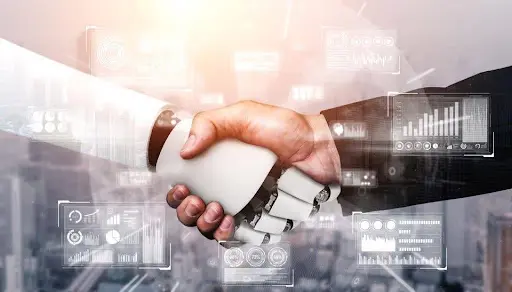
AI + Human Advantage: Winning with AI
Originally published in Forbes Book Author Post, October 2026
Artificial Intelligence (AI) has been a disruptive force, both exciting and challenging, and it’s clearly influencing our lives and careers. Throughout history, we have seen disruptive innovations that have fundamentally changed how and where people work; now we are seeing innovations that fundamentally change what people do. When a task is more routine, because it is repetitive or rules-based, it is more likely to be replaced by automation and artificial intelligence.
For example, we have heard that hand weaving, which skilled workers performed before the 19th-century Industrial Revolution, was a labor-intensive manual routine done on handlooms. Power looms replaced handlooms, allowing factories to operate faster and produce more. Today, we are seeing some knowledge-based routines being replaced by AI. A customer service representative is a good example because most questions are answered manually and can be highly repetitive, such as account information, order status, or troubleshooting problems. Increasingly, AI chatbots and agents are replacing this work because they can interpret and handle these types of questions more consistently.
These are examples of when tasks are more repetitive or algorithmic; whether physical or knowledge-based, they become subject to automation and AI. When a set of rules, defined patterns, or repeatable procedures exists for solving a problem, the role of what people do will change. So how do we compete with the algorithm? We win by partnering with AI.
AI + Work
Because of the pace of disruptive innovation, we are seeing some of the most exciting opportunities, yet also some of the most challenging. AI is both a threat and an opportunity. As a threat, an increasing share of jobs is being affected by AI, with many routine tasks being replaced. At the same time, as an opportunity, many jobs are seeing a significant boost in productivity and efficiency because workers are smarter, faster, and can shift their focus from routine tasks to higher-value tasks. So, AI is no longer optional; it must be part of our toolkit, helping us orchestrate our decisions and actions for faster, better outcomes.
The labor market is shifting as the World Economic Forum projects that AI and other major forces will displace 92 million jobs and create 170 million globally by 2030—a net gain of 78 million jobs.
- AI skills are increasingly valuable in the labor market, with jobs requiring AI skills growing 66% faster than the overall job market.
- AI use is expanding across U.S. occupations, with nearly one in five employees using AI at work several times per week or more.
- State of AI report reveals that 94% of organizations have yet to achieve significant enterprise-level value from AI.
AI + Humanity
I think most of us have come to accept that AI is better at some things, but the reverse is also true – people are better at some things, too. AI excels at information processing, predictive insights, and memory. AI serves as an IQ equalizer because it lets everyone work smarter, more efficiently, and more productively. We still have an advantage in emotional processing, mainly through our curiosity, judgment, and relationship skills. The winners will be those who effectively combine AI for faster, smarter insights with their emotional intelligence.
We have seen how transformative innovations introduce both benefits and challenges when the proper balance is not maintained. For example, social media has been great because it connects us, but it can be inappropriate when what connects us is distorted. With AI, our challenge is to ensure that as AI exceeds more human capabilities, it never exceeds our ability to govern it – maintaining human judgment, accountability, and control. We must also be mindful of our responsibility to preserve humanity’s role and minimize the potential erosion that could prevent us from thinking, creating, and connecting.
- Lead with Curiosity: invest time to understand your environment better.
- Decide with Judgment: learn fast, listen well, and navigate complexity with clarity.
- Scale through Relationships: build trust and credibility through authentic collaboration.
AI + Governance
As AI capabilities grow, organizations must ensure that their ability to govern and maintain human accountability and control grows with them. We should put appropriate safeguards in place to ensure we don’t lose control or accountability. I’m reminded of a profound statement IBM made in 1979: “A computer can never be held accountable; therefore, a computer must never make a management decision.”
Earlier this year, I wrote about what’s coming with AI, and it was titled “Quantum AI: Is This Humanity’s Most Consequential Innovation.” At the time, I was thinking about AI’s pattern-recognition capabilities combined with the computational power of Quantum computing, and how this would enable us to solve problems that challenge today’s classical systems. Still, it would also deliver capabilities that exceed human intelligence. Already, with agentic AI, we are seeing disturbing incidents and ‘calls to action’ to establish more guardrails around some of AI’s unassisted actions. AI has sparked unsettling discussions about potential dangers, and ongoing governance will be required as it gains more decision-making capabilities, but accountability must ultimately remain with humanity.
The Era of Industrial Disruption
To be part of this movement, you want a role that’s more than routine. For college students entering the workforce, the starting line has changed because AI is replacing many routine knowledge-based tasks. AI fluency using AI to solve problems and get work done more efficiently – has become a must-have for any discipline. The currency of your skills matters because competitiveness today requires continuous refreshment. You must embrace the idea that lifelong learning is about constantly investing in new, relevant learning. Workers progressing through the early, middle, and late stages of the career cycle must be committed to constantly enhancing their skills and experience to keep up, stay competitive, and remain relevant. Companies that win will not win just because of the technology they use … their advantage comes from how and how fast they apply technology to solve real business problems at scale and generate strong economics.
i World Economic Forum, Future of Jobs Report 2025.
ii PwC, 2025 Global AI Jobs Barometer.
iii Gallup, AI Use at Work Has Nearly Doubled in Two Years, 2025.
iv McKinsey & Company, The State of AI in 2026: On the Road to ROI, August 25, 2026.
v Rodney C. Adkins, “Quantum AI: Is This Humanity’s Most Consequential Innovation?,” Forbes, April 21, 2026, “Quantum AI: Is This Humanity’s Most Consequential Innovation?”